
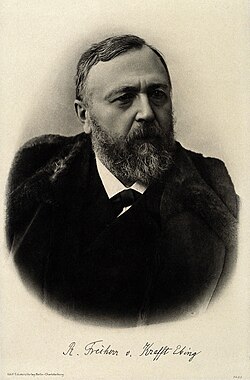
The well-known forensic psychiatrist and physician, Richard von Kraft-Ebing became known as the role model sexologist responsible for the science of sex. In “A Sociology of Sex and Sexuality” we see how the author, Hawkes, gives us an in-depth perspective on Kraft-Ebing’s conducted studies that retained normative elements, while representing indifferent objectivity. Krafft-Ebing conducted hundreds of studies, listing an array of sexual perversions. This infamous sexologist studied perversions ranging from benign fetishes to necrophilia and cannibalism. Kraft-Ebing’s writings on his studies were to remain accessible to the educated rather than to the public, because it was to be used for medical and legal practices of forensic science. His objective during these studies was to record the variations of psycho-pathological manifestations of sexual behavior, in order to reduce these behaviors to be within lawful conditions. Krafft-Ebing’s writings provided a foundation for discerning what sexual behaviors were ‘normal’ versus ‘abnormal’ based on legal context. He distinguished between the two by obtaining wider parameters to what is considered ‘normal’ during the 19th century, such as homosexuality status, masturbation, and the dangers of sexual excess. Kraft-Ebing emphasized the relationship between modernity and unusual sexual behaviors, mental disorders, and nervous diseases; considering these to be ‘abnormal’.
Kraft-Ebing says that during a time of such moral and civil decline in history, it is likely for an individual to expose their most unusual and horrid sexual behaviors. He then explains how these behaviors can be traced back to neuro-pathological or psycho-pathological conditions in an individual. However, what he may have classified as ‘abnormal’ then, does not necessarily stand today. For example, Kraft-Ebing found any deviation from heterosexual intercourse to be pathological. This included gay men, categorizing them as psychologically degenerate due to faulty development. This conflicts with what he considers to be ‘normal’, however it is argued that his studies consisted of such research that is almost impossible to generalize when talking about such a personal and vulnerable topic.
I believe Kraft-Ebing’s studies have an almost inherent and unavoidable influence on how we understand and regulate sexuality today. Growing up in Las Vegas, one of the most “sexually liberated” cities in the U.S., definitely gave me a unique perspective on sexual differences. From a young age, I have considered homosexuals, transsexuals, pansexuals, non-binary, etc. to be ‘normal’, living in a more or so accepting city of the LGBTQ+ community. I have always been able to categorize such sexual behaviors as ‘normal’ that a person living in Provo, Utah, or Oklahoma City might consider to be ‘abnormal’. I believe Kraft-Ebing’s research would be more relevant to people growing up in a less sexually liberated environment, where they may still consider homosexuality to be unusual. While that specific aspect of abnormality may not apply to my perspective, many of the ‘abnormal’ findings continue to be ‘abnormal’ to this day.
Kraft-Ebing was one of the first sexologists to explore horrific sexual fetishes such as cannibalism and necrophilia. He explored how these fetishes were rooted in neuro- or psycho-pathological conditions. I believe we continue to use his findings of such fetishes because they stand today as having underlying neurological or psychological differences compared to ‘normal’ sexual behaviors. He introduced regulating such behaviors to be considered ‘abnormal’ and connected to mental disorders or nervous diseases. While there still may be limited neuroscientific research on the true psychological and neurological underlying findings regarding such harmful behavior, Kraft-Ebing’s research has provided us with a foundational understanding of ‘normal’ versus ‘abnormal’ sexual behavior. Overall, it is important to acknowledge the societal improvements and changes that researchers have made regarding abnormalities in sexual behavior, where homosexuality is now generally normalized and no longer considered an abnormality.
Citation: Hawkes, G. (1996). The sociology of sex and sexuality. Open University Press.
 An educational weekly blog post on sex and sexuality in sociology. A college students perspective and insight on her SOC 449 university class.
Leave a comment